
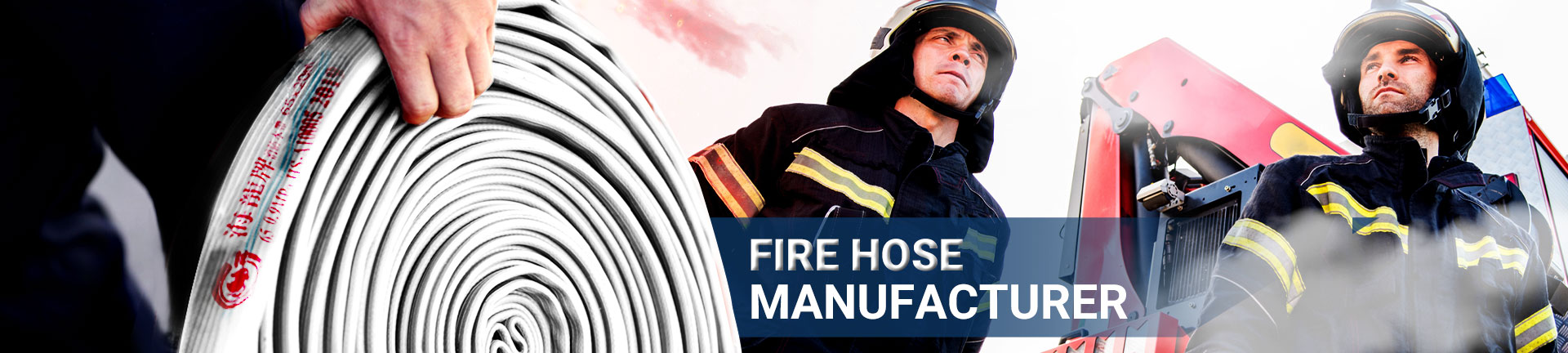


Fire Hose Pressure Ratings and Testing: How to Write Procurement Specifications That Pass Inspection and Deliver Long-Term Reliability
In building projects and industrial fire protection maintenance, fire hoses are often treated as consumable items. In reality, they are one of the most critical lifelines on the fireground.
As Taiwan’s first and only manufacturer to receive type approval for semi-rigid fire hoses, Sochiao Industrial Co., Ltd., under the Hai-Long brand, understands one thing clearly: a poorly written procurement specification does more than delay inspection. It can lead to hose rupture, leakage, coupling failure, or equipment that does not perform when it matters most.
This article explains how fire hoses should comply with Taiwan fire safety regulations and how procurement teams, facility managers, contractors, and fire safety professionals can write specifications that support both smooth acceptance inspection and long-term reliability.
1. The Cost of Poor Specifications: Failed Inspection, Added Costs, and Unclear Liability
Many procurement documents describe the requirement only as “1.5-inch × 15 m fire hose.” That may seem clear enough at first glance, but without pressure rating, material requirements, coupling standards, and approval documentation, several problems can occur.
Failed inspection:
After installation, the hose may be found non-compliant with Taiwan’s fire equipment type approval requirements, forcing the owner or contractor to replace the entire batch.
Disputes over responsibility:
If leakage or coupling separation occurs during pressure testing, and the contract does not specify the coupling standard, it becomes difficult to determine whether the problem came from installation quality or product quality.
Hidden long-term costs:
Low-grade hoses may mildew, age, crack, or deteriorate in humid environments. Two or three years later, during routine fire safety inspection reporting, the property may receive a correction notice and be forced to repurchase replacement hoses. In many cases, the total cost of repeated replacement is far higher than choosing a reliable Made-in-Taiwan fire hose from the beginning.
2. How to Select the Right Pressure Rating: Application, Risk, and Operator Capability
The pressure rating of a fire hose must match the building application, fire pump head, system pressure, and expected operating conditions.
According to Taiwan’s fire hose approval requirements, common working pressure ratings range from 0.7 MPa to 2.0 MPa. Choosing the wrong pressure rating may affect firefighting performance and may also increase the risk of burst failure, leakage, excessive stiffness, or operating difficulty during an emergency.
Fire Hose Pressure Rating Selection Guide
| Pressure Rating / Type | Structural Features | Recommended Applications |
| DJ Double-Jacket Hose | Double-layer jacket with excellent abrasion resistance | Fire departments or high-pressure, high-abrasion environments |
| 2.0 MPa | Special abrasion-resistant construction | Industrial facilities and fire department use |
| 1.6 MPa | Dense single-jacket construction, balancing pressure resistance, abrasion resistance, and flexibility | High-rise buildings, factories, warehouses |
| 1.3 MPa | High performance, lightweight, easy to operate | Indoor and outdoor fire hydrant systems |
| 0.9 MPa | Reliable performance with cost efficiency | Pumps, indoor and outdoor hydrants, farms, pools, factories, and general facilities |
Key Selection Criteria
When selecting the pressure rating, procurement teams should evaluate three conditions at the same time:
- Fire pump head and system pressure
- Building height and hose deployment distance
- Training level of the expected operators
For example, high-rise buildings may require hoses rated at 1.6 MPa or above because of higher system pressure at certain points. For general residential buildings, offices, public facilities, and Type 2 indoor fire hydrant systems, 0.9 MPa or 1.3 MPa hoses are commonly used.
3. Why Semi-Rigid Fire Hoses Matter
Semi-rigid fire hoses, including products developed by Sochiao, are increasingly important in Taiwan’s fire safety system, especially for facilities where a single person may need to operate the hose during the early stage of a fire.
Their main advantages include:
Suitable for Type 2 indoor fire hydrant systems
Semi-rigid hoses are designed to comply with Taiwan’s current requirements for Type 2 indoor fire hydrant systems and related installation practices.
Single-person operation
The hose can be handled by one person independently. Lower reaction force and easier deployment help reduce response time during the first few minutes of a fire.
Lightweight and abrasion-resistant
Compared with traditional lay-flat hoses, semi-rigid hoses are lighter, easier to deploy, and less likely to twist or interrupt water flow when bent.
Ideal for non-professional users
Hospitals, schools, long-term care facilities, hotels, apartment buildings, and public spaces often rely on staff, residents, or facility personnel to respond before firefighters arrive. Semi-rigid hoses are more practical for these real-world conditions.
Why Are Semi-Rigid Hoses Being Promoted?
During the first five minutes of a fire, the people on site are often not professional firefighters or trained fire safety managers. A semi-rigid hose makes it possible for an adult on site to respond quickly and operate the equipment alone.
That is why Taiwan’s fire safety authorities continue to promote Type 2 indoor fire hydrant systems using semi-rigid fire hoses: they improve first-response capability before the fire escalates.
4. Testing and Factory Documentation: What Evidence Should Buyers Request?
To ensure the fire hose complies with Taiwan fire safety requirements, procurement teams should verify three essential documents before purchase and acceptance inspection.
1. Type Approval Certificate
This confirms that the hose model has passed laboratory testing according to applicable national standards, CNS requirements, or recognized approval criteria.
2. Individual Approval Label
Each fire hose leaving the factory must carry an individual approval label issued by an organization authorized by Taiwan’s National Fire Agency. This label is one of the most important documents during acceptance inspection.
3. Factory Inspection Report
A qualified Made-in-Taiwan manufacturer such as Sochiao operates under ISO 9001 quality management and can provide internal inspection records, including tensile strength, adhesion strength, and hydrostatic pressure testing.
These documents are not just paperwork. They are the foundation for traceability, inspection acceptance, and long-term maintenance accountability.
5. Common On-Site Testing Issues: Pressure, Duration, Couplings, and Leakage Judgment
Correct Hydrostatic Pressure Testing Method
During fire equipment acceptance inspection, the on-site hydrostatic test should generally be conducted at 1.5 times the working pressure and maintained for at least five minutes.
The test should confirm that the hose body does not leak, rupture, deform abnormally, or separate from the coupling.
Coupling Separation and Leakage Judgment
In many cases, leakage during on-site testing is not caused by the hose body itself. It is often related to poor coupling installation, aging gaskets, or improper quick-connect fitting engagement.
Sochiao recommends using couplings that comply with the approval requirements for fire hose quick-connect couplings. Procurement specifications should also require corrosion-resistant materials, secure assembly, and gasket quality verification.
If leakage appears at the coupling, the gasket and coupling alignment should be checked first. If water seeps through the hose jacket or liner, the hose should be treated as non-compliant.
6. Building a Traceable Procurement System: Batch Numbers, Records, and Spare Hose Strategy
A professional fire hose specification should include traceability clauses. This helps property owners, contractors, and facility managers avoid disputes and maintain long-term compliance.
Batch Number Management
Require the supplier to provide the manufacturing date and batch number. This helps confirm that the hoses are not old inventory and allows future maintenance records to be traced back to a specific production batch.
Spare Hose Strategy
For large projects or multi-floor buildings, it is recommended to purchase approximately 5% additional spare hoses for replacement during annual inspection, maintenance, or emergency repair.
The Advantage of Made-in-Taiwan Manufacturing
Choosing a local manufacturer such as Sochiao, under the Hai-Long brand, provides stronger quality control through integrated production, faster technical support, and more responsive after-sales service. For contractors and facility owners, this can significantly reduce replacement risk and inspection uncertainty.
7. Fire Hose Procurement Specification Checklist
The following table can be used as a practical RFQ template when preparing fire hose procurement documents.
| Specification Field | Recommended Content | Key Inspection Point |
| Nominal Diameter | 40 mm / 1.5 in, 50 mm, 65 mm / 2.5 in | Must match hydrant cabinet and system design |
| Length | 10 m, 15 m, 20 m | Must cover the farthest required point on the floor |
| Working Pressure | 0.9, 1.3, 1.6, or 2.0 MPa | Must correspond to fire pump data and system pressure |
| Coupling Specification | Approved quick-connect coupling | Must be corrosion-resistant and securely installed |
| Approval Certificate | Fire equipment type approval and individual approval | Valid approval number must be provided |
| Required Documents | Approval label, product warranty, ISO certificate, inspection report | Supports future maintenance and traceability |
FAQ: Fire Hose Pressure Rating, Testing, and Procurement
Q1. Is a higher pressure rating always better?
Not necessarily. The correct pressure rating should match the fire protection system. A hose with an unnecessarily high pressure rating may become heavier, stiffer, and more difficult to handle. In real-world fire response, stability, usability, and system compatibility are more important than simply choosing the highest rating.
Q2. How should leakage during on-site testing be judged?
Under the required test pressure, the hose body should not leak, rupture, or separate from the coupling. Slight dripping at the coupling may be caused by gasket installation or poor coupling engagement. However, if water seeps through the hose body or jacket structure, the hose should be considered non-compliant.
Q3. How often should fire hoses be tested or replaced?
Fire safety equipment must be inspected and reported regularly according to applicable regulations. As a practical maintenance guideline, fire hoses should be evaluated every three to five years. If the outer jacket is damaged or the inner lining becomes brittle, the hose should be replaced immediately.
Q4. Who should sign off during acceptance inspection?
Testing and inspection should be performed and certified by a qualified fire protection engineer or fire safety equipment professional. The building owner, management committee, facility manager, or industrial safety department should also participate in the acceptance process.
Q5. How long should approval documents be kept?
Procurement and approval documents should be retained until the corresponding batch of fire hoses is replaced. During fire department inspections or periodic compliance checks, these documents serve as proof that the equipment was legally approved and properly procured.
Q6. How can buyers prevent suppliers from switching to lower-grade products?
The contract should include a random sampling and third-party testing clause. Buyers should also verify that the printed hose markings, batch numbers, approval labels, and certificates are consistent. Working with a reputable Made-in-Taiwan manufacturer such as Sochiao is one of the most effective ways to reduce this risk.
Conclusion: Choose Sochiao for Fire Hose Reliability You Can Trust
Fire protection equipment is an investment in the one moment no one can afford to get wrong.
Since 1980, Sochiao Industrial Co., Ltd. has continued to serve Taiwan’s fire safety market with a commitment to quality, reliability, and responsible manufacturing. Under its Hai-Long brand, Sochiao provides approved fire hoses, semi-rigid fire hoses, and related fire hose accessories designed for compliance, inspection confidence, and long-term field performance.
For contractors, facility managers, building owners, and fire safety professionals, a well-written specification is the first step toward safer buildings and fewer inspection risks.
Request Professional Specification Support
Sochiao can help you select the right fire hose pressure rating, approval documentation, coupling configuration, and procurement specification for your project.
Contact Sochiao Industrial Co., Ltd.
Tel: +886-4-2271-5577
Fax: +886-4-2271-6677
Address: No. 80, Zhengguang St., Taiping Dist., Taichung City 41173, Taiwan
Contact us to build fire hose specifications that support smooth inspection and long-term fire safety reliability.